
Artpoint: when digital art transforms our spaces and the way we live

The “Au Féminin by SGPB” club highlights inspiring women who stand out in their ecosystems. Created four years ago, it demonstrates the ambition of a responsible private bank supporting women who wish to take an active role in their wealth and financial decisions.
This series of interviews opens a window onto shared journeys. A duo — sometimes a collective — advancing together and turning intuition into a project. A woman always plays a central role: through her vision, her determination, her way of acting. Together, they create a unique dynamic built on trust, discipline and momentum. Their story reveals the strength of doing things together, the richness of paths that converge and the power of values that unite us — entrepreneurship, innovation, excellence, teamwork and transmission.
Marceline Try, Head of Network Development and Partnerships at Societe Generale Private Banking, spoke with Laurie Bonin and Julie Corver who founded the digital art agency Artpoint in 2019 based on a strong conviction: that digital art has a rightful place in spaces where people live, work and gather. At the intersection of innovation, workplace wellbeing and spatial transformation, their approach seeks both to showcase the emotional power of digital art and to democratise access to contemporary creative expression.
Tell us about Artpoint and how it came to life.
Laurie Bonin and Julie Corver: Artpoint was founded in 2019, but its story began earlier, when we met during our studies—a meeting that literally changed the course of our lives. As early as 2018, we realized that digital art was pushing the boundaries of creative expression and unlocking new forms of emotion at the intersection of art and technology. We quickly recognized its ability to create sensitive and immersive experiences, as well as its potential to bring contemporary art into economic and cultural spaces, as well as everyday environments. Today, Artpoint is a digital art agency that connects the world’s most innovative brands and institutions with leading international digital artists to create inspiring and memorable experiences.
Laurie: Our ambition is to break down barriers around art and take it beyond traditional institutions, bringing it directly to audiences. Businesses, institutions, public spaces—we integrate artworks into the places people experience every day. We re-enchant these environments through a new generation of visionary artists who fully harness the power of digital technologies, networks, and virtual worlds. These artists are highly aware both of their ability to reinvent art and of the need to work alongside strong partners. We pursue a dual mission: supporting artists by providing new exhibition opportunities and revenue streams through copyright royalties, while transforming spaces into sensory experiences. Making this encounter possible draws on many disciplines: spatial design, technology, emotion, and storytelling.
Julie: Today, Artpoint represents more than 500 artists from 70 different nationalities, with a catalogue of over 10,000 artworks. The impact is real and measurable: being exposed to art at least once a month significantly reduces the risk of depression, and more than half of employees working in artistic environments report increased creativity. We are not a healthcare company, but we are convinced that we contribute positively… to health.
How would you define your partnership?
Laurie: There is such a thing as a professional love at first sight—and I experienced it with Julie. Our partnership is intense and constantly evolving. We are deeply aligned in our entrepreneurial vision and in what we want to build through Artpoint. Trust is a fundamental pillar, as are our different yet perfectly complementary personalities.
Julie: Our strength comes from this natural understanding, but also from our complementarity. There are areas where Laurie excels more than I do, and vice versa. The value we create is built first and foremost on our respective talents. We have learned to divide responsibilities very naturally by leveraging our strengths.
Has your business partnership changed your relationship?
Laurie and Julie: Not at all. We are friends both at work and in life, with genuine admiration for one another. We sometimes joke about being in a “professional marriage,” which says a lot about our mutual commitment. Close and complementary—that is precisely what makes our partnership so strong.
Is it still possible to innovate in a sector as established as contemporary art?
Laurie and Julie: Contemporary art can sometimes feel highly institutionalised, with well-established codes and practices. Introducing innovation—particularly through digital technologies—without falling into gimmickry is a real challenge. From the beginning, we have approached our work through the lens of value creation. We are not seeking to disrupt simply for the sake of disruption. Instead, we aim to build something sustainable and meaningful by identifying the most attractive distribution model for artists, venues, and audiences.
Julie: As surprising as it may seem, many avant-garde digital artists still lacked visibility within institutions that themselves claimed to be avant-garde. There was therefore a gap to fill and a new ecosystem to invent—one that could support these artists and promote another form of culture. Helping a new generation of artists emerge is also at the heart of our commitment.
Laurie: We want to appeal both to passionate art enthusiasts and to people who would not naturally walk through the doors of a museum or gallery. From the outset, our ambition has been universal, with a strong educational dimension. Some artworks may be complex, but Artpoint demonstrates that art can have a positive impact and create meaning both for artists and for those who discover their work.
What is your perspective on the rise of artificial intelligence in digital art?
Laurie and Julie: Digital art reflects the technological developments of its time, as artists have always embraced the tools available to them, questioning them and exploring their creative potential. This was true of 3D technologies, Internet, virtual reality, robotics, and now artificial intelligence (AI). However, AI is reshaping the role of the artist in the creative process and raises a fundamental question: what truly qualifies as art, and what does not? Artificial intelligence is part of this technological continuum, but it challenges us to reconsider the nature of artistic creation itself. In this context, Artpoint’s role is essential in making that distinction. We identify artists who use these technologies as genuine creative mediums rather than simple production tools. AI serves an artistic vision and a creative process.
Your project is built around a strong CSR approach. How does this translate into practice?
Laurie and Julie: Artpoint is now seven years old—an age often associated with maturity. Despite how far we have come, we remain a young organisation. We firmly believe that art can contribute to a more sustainable and inclusive future by raising awareness and fostering dialogue. Digital art significantly reduces transportation requirements and the use of physical materials, making it a relevant response to today’s environmental challenges. However, digital technologies are not impact-free. That is why, with support from Bpifrance, we have implemented an ambitious action plan to reduce our environmental footprint and obtained the Responsible Digital certification.
Julie: We are deeply committed to making Artpoint a credible player in the ecological transition within a sector that is still not sufficiently aware of these issues.
Laurie: This commitment, both internally and externally, is something we carry collectively alongside our clients, partners, employees, and investors. It is a profoundly collective journey.
More broadly, values seem to play a central role in your vision. How do you view the future?
Laurie and Julie: We are still young and highly focused on developing our business, accelerating growth, and strengthening our credibility. We are beginning to gain recognition in the art world, and this interview with Societe Generale—an institution we also admire for its remarkable contemporary art collection—is an important sign of recognition. We are convinced that values such as sharing, openness, social diversity, and environmental responsibility form the foundation of a sustainable business. They guide our journey as entrepreneurs—and perhaps as mothers in the future.
What advice would you give to people looking to start a business in a very established sector?
Julie: Create your own opportunities: dare to act, speak up, meet people, exchange ideas, and make mistakes. That is how you learn and avoid pitfalls. Our Master’s program director used to say, “Throw them into the water—they’ll swim!” He was right.
Laurie: And above all, do not wait until your project feels perfectly complete before getting started. The pursuit of the perfect project is often an illusion. Success is built by moving forward, taking risks, and sharing your ideas with others.
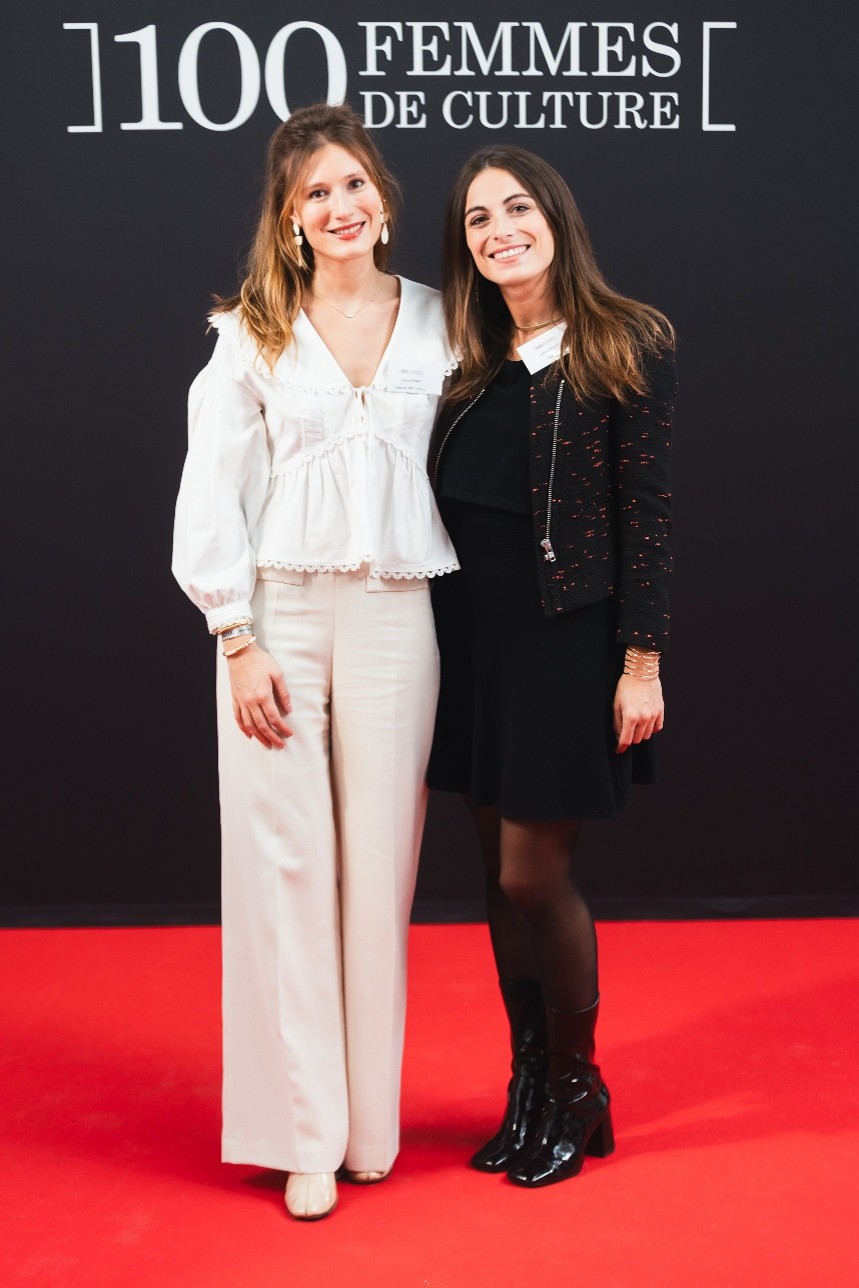
Laurie Bonin and Julie Corver founded Artpoint in 2019.
In 2022, they were among the collective of 128 leaders from the tech and crypto sectors, alongside artists, investors and business executives, who founded NFT Factory, a venue created to raise public awareness of NFTs, bring together stakeholders from the Web3 ecosystem, and help build a French Web3 community.
In 2024, they were named among the "100 Femmes de Culture" award recipients, in recognition of their pioneering commitment to the arts.
In 2026, Laurie Bonin was selected as a laureate of the inaugural Choiseul Médias & Création ranking.
DISCLAIMER
This document has no contractual value. It is not intended to provide an investment service such as investment advice, a related investment service, arbitration advice or legal, accounting or tax advice from Société Générale Private Banking France (‘SGPB France’), which cannot therefore be held liable for any decision taken by an investor solely on the basis of its content. SGPB France undertakes neither to update nor to modify it.
Before making any investment decision, please review the details of the documentation for the service or product being considered, including any associated risks, and consult your legal and tax advice. If the document is consulted by a French tax non-resident, he or she will have to ensure with his or her legal and tax advisors that he or she complies with the legal and regulatory provisions of the jurisdiction concerned. It is not intended for distribution in the United States, or to a U.S. tax resident, or to any person or jurisdiction for which such distribution would be restricted or unlawful.
The past performance information that may be reproduced is not intended to guarantee future performance. These future performances are therefore indicative. The return to investors will vary depending on market performance and the shelf life of the investment. Future performance may be subject to tax, which depends on your present and future personal situation.
Societe Generale has put in place a policy to manage conflicts of interest. SGPB France has put in place (i) a policy to handle complaints made by its customers, available on request from your private banker or on its website and (ii) a policy to protect personal data (https://www.privatebanking.societegenerale.com/fr/protection-donnees-personnelles/). At any time and without charge, you have the right to access, rectify, limit processing, erase your data and the right to object to their use for the purposes of commercial prospecting by contacting our Data Protection Officer by email (protectiondesdonnees@societegenerale.fr). In the event of a dispute, you can lodge a complaint with the Commission Nationale de l’Informatique et des Libertés (CNIL), the supervisory authority responsible for compliance with personal data obligations.

No matter where you spent your summer holidays or when you took them, chances are you had the opportunity to enjoy the...
Clémentine Gallès on the program USA Today - BFM Business - 16/09/2026
After several years marked by rising interest rates and slower transaction activity, residential real estate is...
Samia Yakoubi sur Les Echos - La grande transmission

Preserving a company’s independence while giving its succession a philanthropic dimension: this is the ambition behind...