
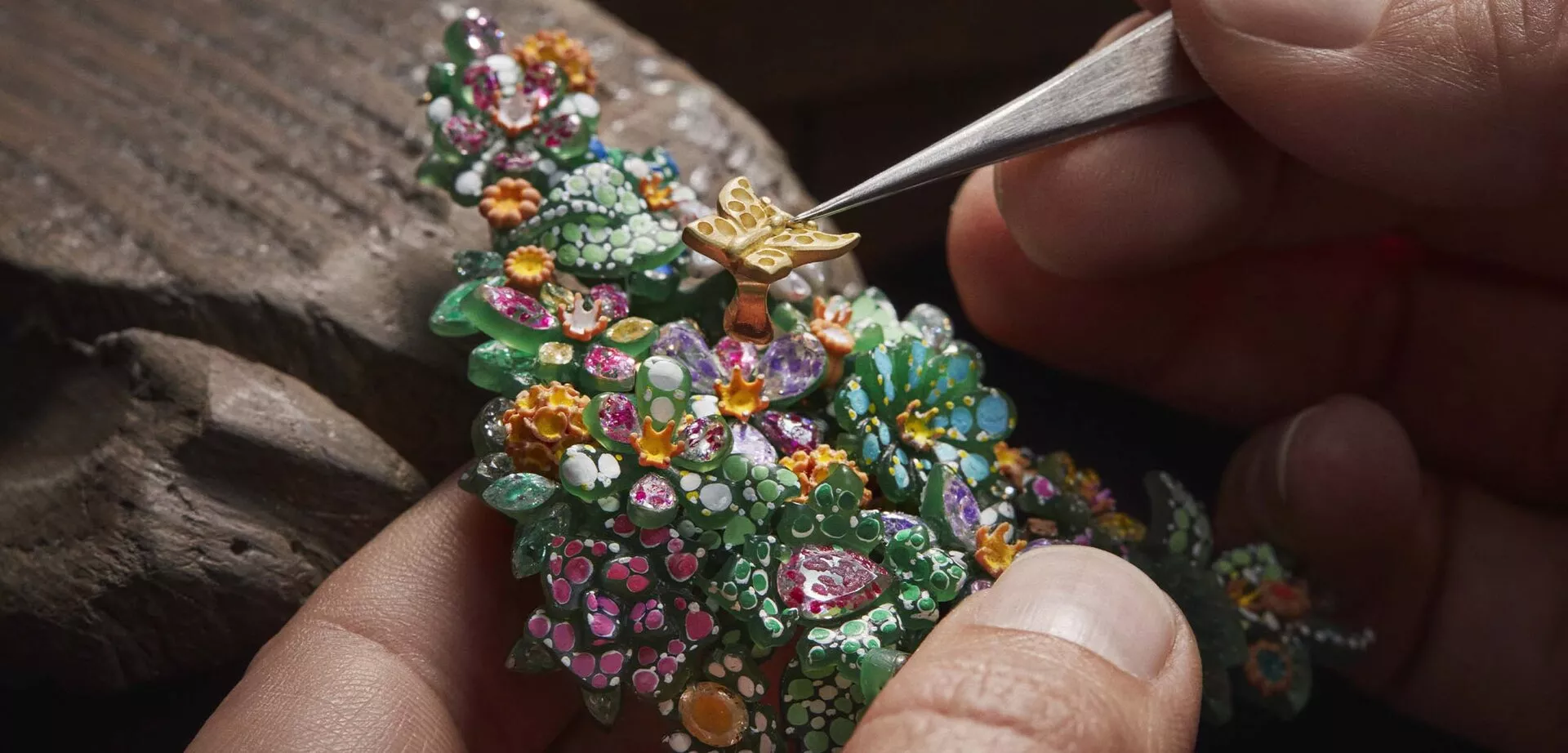
Chantal Maquaire, an exceptional journey in the service of high jewelry
The only woman to have earned the prestigious title of Meilleur Ouvrier de France in jewelry-making, Chantal Maquaire is the Director of High-end Jewelry at Oteline, the firm she founded over twenty years ago. Driven by passion and uncompromising integrity, she reflects on a singular journey – from her garage workshop to Dior – built through dedication and relentless hard work. In early 2026, she was awarded the rank of Chevalier de l’Ordre des Arts et des Lettres.
You turned to jewelry at the age of 14. How did your early career unfold?
I faced academic difficulties very early on. I repeated my first year of primary school and then sixth grade – it became clear that a traditional academic path was not for me. My father was an auto body mechanic, and working with metal naturally led me towards jewelry. I joined the SEPR school in Lyon to pursue a CAP vocational course in jewelry-making, followed by a CAP in high-end jewelry through evening classes, while beginning my professional career at the same time.
Internships and early roles allowed me to refine my craftsmanship and improve my efficiency. I aspired to become a model maker – a profession that was largely male-dominated at the time. Marie Michaud Créations gave me that opportunity: it truly launched my career, and I stayed there for seven years.
Then came the desire to strike out on my own. My husband encouraged me to take the leap. I lacked confidence commercially, but he supported me with communication, prospecting and client development. I began in my garage, working for three years without any salary, day and night. There were sacrifices, including sending our daughter to boarding school.
Yet it was in that very garage that I created one of my most remarkable items: a piece of jewelry designed for the rear headrests of a car. Only two pieces were made, but they required absolute precision – they had to be strictly identical. It was an immensely valuable learning experience.
You have proven yourself not only as a master jeweler but also as an entrepreneur. How would you describe Oteline?
In 2003, I founded Oteline with two partners. I needed a collective dynamic – working alone had become limiting. This partnership helped me structure my approach and learn. Building a brand requires considerable resources, particularly in communication. It was a demanding experience, but deeply formative: learning how to approach major jewelers, justify a quote and position oneself properly.
Over time, our paths diverged. In 2011, I found myself solely in charge. I faced several challenges: securing financing proved difficult, and an associate left, taking my two largest clients with them. I chose to turn these setbacks into a driving force. When I believe in a project, seeing it through is part of my DNA.
Through trade shows, Oteline caught the attention of Dior. The story could have ended quickly: we were unable to deliver a complex ring due to a design flaw – and even Dior’s partner workshop could not resolve it. Paradoxically, this episode laid the groundwork for a relationship built on mutual respect and trust.
At the end of 2011, I met Victoire de Castellane, Artistic Director of Dior Joaillerie – an extraordinarily talented woman. Her creations, to me, are like a garden: poetic, colorful and airy. This meeting made the sale of Oteline to Dior an obvious choice: the opportunity to deepen our collaboration convinced me. Jewelry is a profession of passion – and Victoire inspires me.
Since its acquisition by Christian Dior Couture in 2022, Oteline works exclusively on commission for the House of Dior. How is a high-end piece of jewelry created, from the initial sketch to delivery?
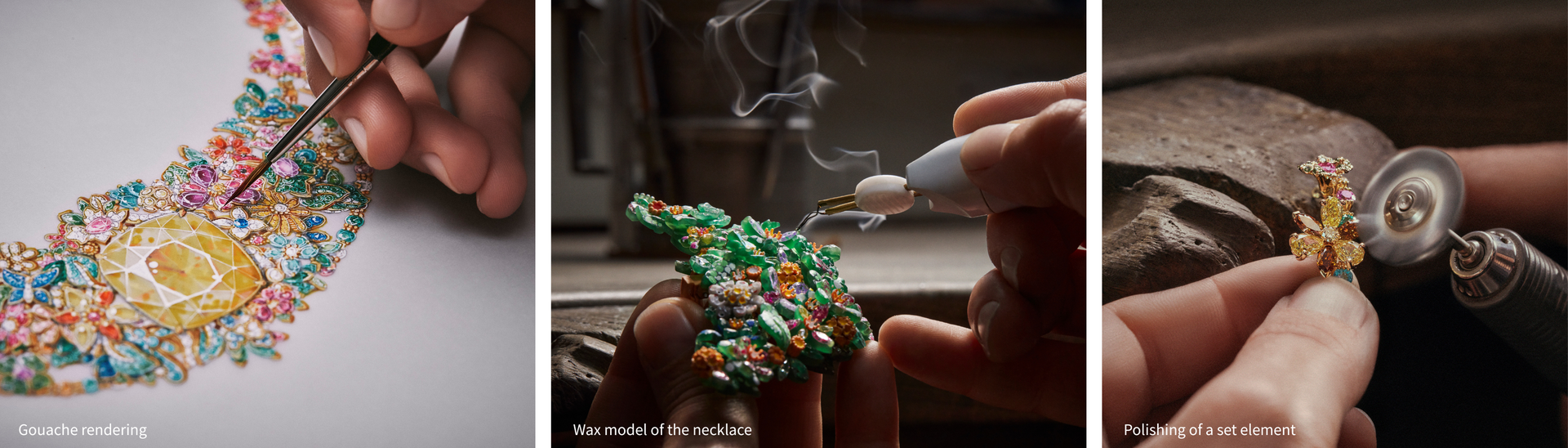
Everything begins with a story. Victoire de Castellane builds her creative worlds from images, sensations and very tangible references. The studio produces gouache drawings, which she refines before sending them to us.
We then develop prototypes to shape the collection’s identity while preserving its DNA. We typically collaborate with four or five workshops. This diversity of perspectives enriches the collection, provided a strong common thread is maintained.
Once developments are finalized, we create mock-ups in bronze or resin. The pieces constantly evolve through adjustments, refinements and successive approvals. Then comes the final production phase.
We use CAD (Computer-Aided Design), 3D printing, and lost-wax casting — an ancestral technique. Each piece is assembled like a puzzle: jewelry-making, fitting, polishing, stone setting and final assembly. A necklace can comprise up to 400 elements. It takes nearly two years to bring a high-end piece of jewelry to life, from the first gouache to final delivery.
Is there a particular piece that holds special meaning for you?
I first think of the pieces that enabled us to access the major jewelry houses. Not necessarily the most beautiful, but those that opened doors, secured contracts and helped Oteline grow.
There is also the piece that earned me the Meilleur Ouvrier de France title in 2018. This initiative, once again, was encouraged by my husband for Oteline’s twentieth anniversary. He pushed me to overcome a humility that is often too present among women.
I embarked on it to share my expertise and help preserve this craft. And if my journey can open doors for other women – go for it. You belong here. Don’t remain in the shadows.
How have you introduced innovation into a craft rooted in tradition and manual expertise?
Innovation is essential – even, and especially, in craftsmanship. We must preserve the DNA of the craft while allowing it to evolve so it can endure.
At Oteline, we were pioneers in working with titanium in France. It is a complex yet extraordinary material: extremely lightweight, it enables volumes that would otherwise be impossible. It can also be colored, giving each piece of jewelry a unique character. We have created exceptional pieces, notably with Taiwanese designer Cindy Chao, and won an award together in London.
What is your outlook on the future of French high-end jewelry – and on your own journey?
I am convinced that many remarkable creations still remain to be imagined. Technologies are evolving rapidly, opening new perspectives in materials and research.
However, I observe the rise of artificial intelligence with caution. It can threaten certain creative professions. The challenge is to strike the right balance: preserving craftsmanship and expertise while integrating the demands of speed and efficiency.
I also believe in the importance of regulation: synthetic diamonds, metal traceability, environmental respect and social responsibility. These are essential issues to protect both the craft and the people behind it.
My greatest pride lies in my teams. Without them, nothing would have been possible. I have the ability to bring people together and carry them forward. Oteline stands not only for craftsmanship but also for values: respect, honesty and leading by example. Success should never come at the expense of others.
Inspiring younger generations, passing on a strong work ethic and training individuals capable of upholding these values – I am deeply committed to supporting the next generation and ensuring that this beautiful craft endures.
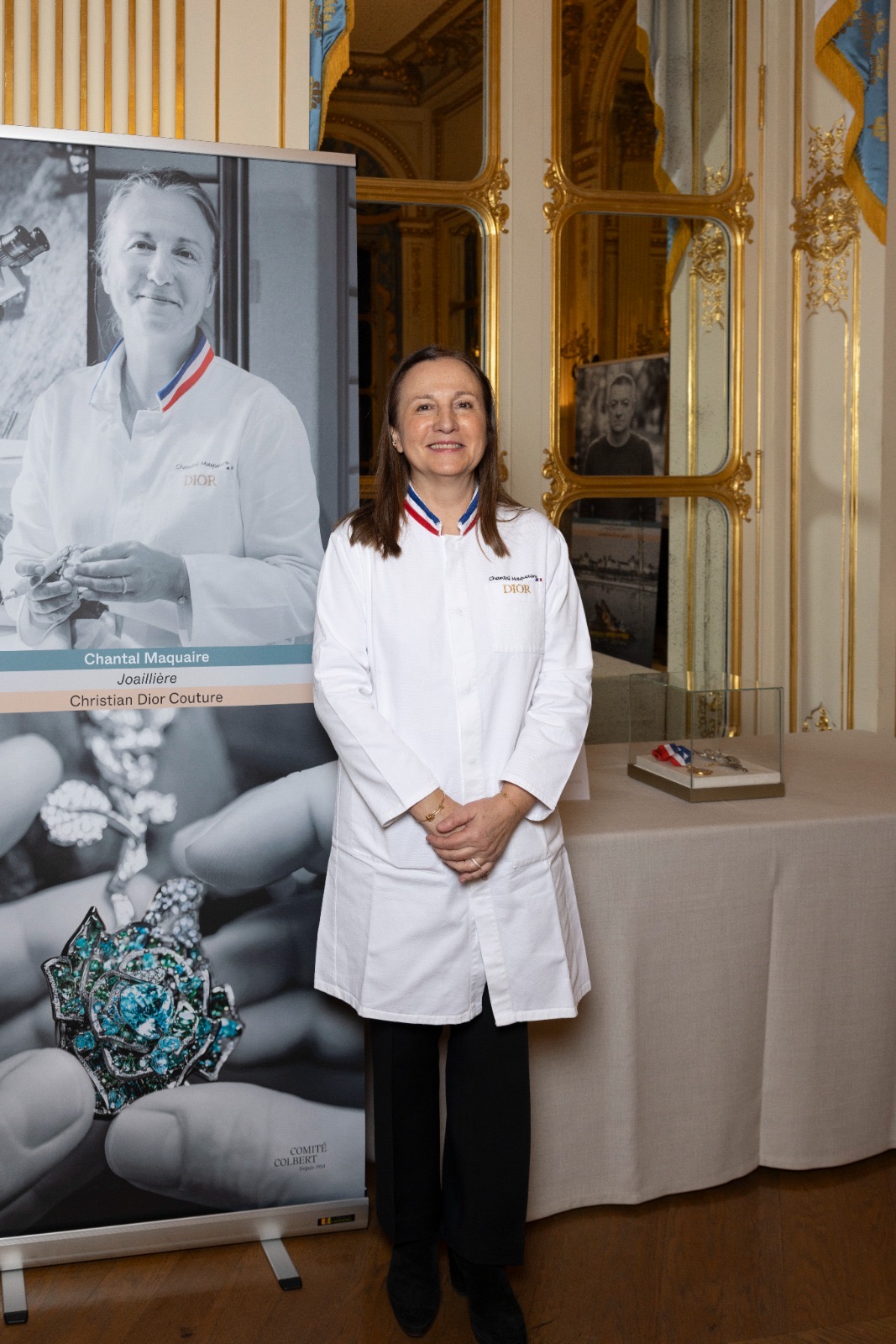
Chantal Maquaire
Founder of Oteline, a workshop that has become a benchmark in the creation of high jewellery pieces for some of the world’s most prestigious luxury houses, Chantal Maquaire has distinguished herself through her exceptional expertise and pioneering mastery of anodized titanium.
The first and only woman to be awarded the title of Meilleur Ouvrier de France in Jewellery, Chantal Maquaire embodies the excellence of French craftmanship. Her career was recognised in 2026 when she was appointed Chevalier de l’Ordre des Arts et des Lettres.
DISCLAIMER
This document has no contractual value. It is not intended to provide an investment service such as investment advice, a related investment service, arbitration advice or legal, accounting or tax advice from Société Générale Private Banking France (‘SGPB France’), which cannot therefore be held liable for any decision taken by an investor solely on the basis of its content. SGPB France undertakes neither to update nor to modify it.
Before making any investment decision, please review the details of the documentation for the service or product being considered, including any associated risks, and consult your legal and tax advice. If the document is consulted by a French tax non-resident, he or she will have to ensure with his or her legal and tax advisors that he or she complies with the legal and regulatory provisions of the jurisdiction concerned. It is not intended for distribution in the United States, or to a U.S. tax resident, or to any person or jurisdiction for which such distribution would be restricted or unlawful.
The past performance information that may be reproduced is not intended to guarantee future performance. These future performances are therefore indicative. The return to investors will vary depending on market performance and the shelf life of the investment. Future performance may be subject to tax, which depends on your present and future personal situation.
Societe Generale has put in place a policy to manage conflicts of interest. SGPB France has put in place (i) a policy to handle complaints made by its customers, available on request from your private banker or on its website and (ii) a policy to protect personal data (https://www.privatebanking.societegenerale.com/fr/protection-donnees-personnelles/). At any time and without charge, you have the right to access, rectify, limit processing, erase your data and the right to object to their use for the purposes of commercial prospecting by contacting our Data Protection Officer by email (protectiondesdonnees@societegenerale.fr). In the event of a dispute, you can lodge a complaint with the Commission Nationale de l’Informatique et des Libertés (CNIL), the supervisory authority responsible for compliance with personal data obligations.
Initiated by Belgian Entrepreneur Walter in the mid-1970s, the Vanhaerents Art Collection will celebrate twenty years of...
As a child, Priscillia Leal Torres was captivated by books, thrilled equally by the imagination of their content and the...

Christophe Lasserre-Ventura préside depuis 1995 l’association Perce-Neige, poursuivant le combat initié par son...
The 2025 “primeur” campaign, unfolding in spring 2026, comes in a particularly distinctive context: a vintage of...