
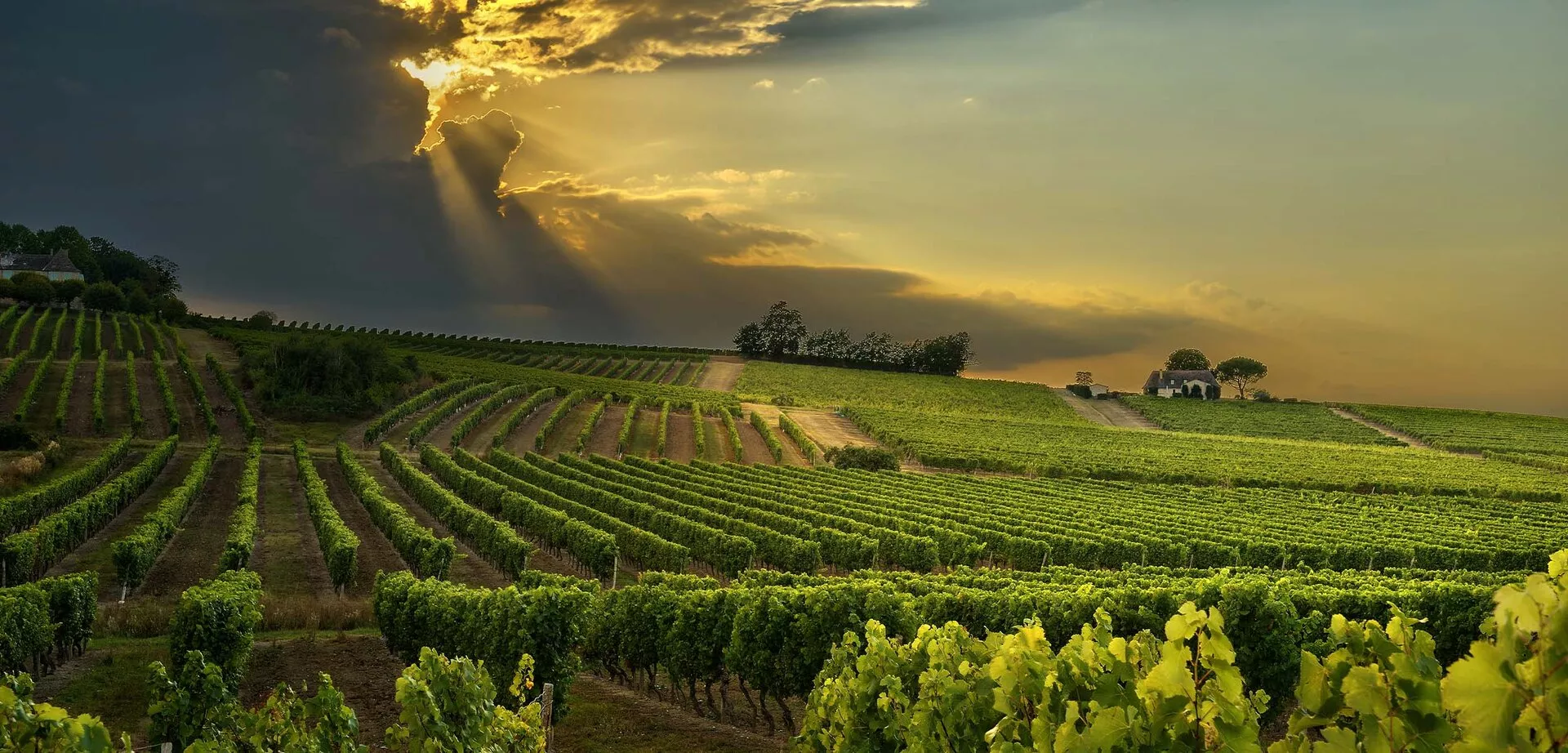
Future vintage perfect?
Rising temperatures, delayed frosts, heatwaves, recurring droughts, unpredictable seasons... Climate disruptions are redrawing the global map of wine-growing regions. Faced with these phenomena, which impact the entire wine industry, stakeholders are deploying various strategies to help preserve production conditions and wine quality.
Even though the vine is a Mediterranean plant known for its resilience, the climate disruptions of the past twenty years have increasingly forced winegrowers to adapt. The steady rise in temperatures has significantly accelerated the ripening of grapes, leading to an increase in sugars and consequently the alcohol content of wines. As a result, harvests are taking place earlier and earlier, sometimes as early as the end of July, which is changing the chemical composition of the grape and the taste profile of wines, in particular due to a decrease in their acidity. In parallel, the spread of new pests, such as the leafhopper, responsible for flavescence dorée1, and diseases such as esca or black rot, also represent major challenges for the industry. Faced with these new realities, wine-growing estates are needing to evolve their management and production strategies.
A new geography of wines
The world map2 of wine-growing regions is certainly being redrawn. Indeed, whilst wine production is technically possible in almost all regions of the world, producing quality wine at economically viable yields remains a major challenge. According to a study conducted by INRAE, Bordeaux, Sciences Agro, CNRS, the University of Bordeaux and the University of Burgundy, historic vineyards are the most vulnerable to climate change.
Around 90% of traditional coastal and low-altitude wine-growing regions in southern Europe (Spain, Italy, Greece) and southern California risk losing their ability to produce quality wine at economically viable yields by the end of the century, if global warming exceeds +2°C. However, if it remains below the 2°C global threshold—as set by the Paris Agreement3 in 2015—most of these regions will be able to continue their activity, provided they implement adaptation measures.
Conversely, the study also shows that rising temperatures could make new regions more suitable for quality wine production. Thus, the north of France, the American states of Washington and Oregon, British Columbia in Canada, and Tasmania in Australia appear as new potentially favourable territories. Even more surprising, countries such as Belgium, the Netherlands or Denmark could also emerge on the global map of wine-producing regions.
Fragile farms
In France, where the wine industry represents a major economic and cultural pillar, the consequences of climate change are increasingly tangible. Before the Covid crisis, wine was the country's second largest export sector4, after aeronautics, with a turnover of more than 13 billion euros. Today, climate variability is jeopardising this performance and leading to significant yield reductions. While the southern regions—Languedoc, Provence, Rhône Valley—are the most exposed to droughts and fires, the Bordeaux region is also suffering losses due to disease and water stress, with the northern vineyards (Loire, Alsace, Champagne) increasingly exposed to the threat of late frosts.
This lack of stable conditions weakens farms, particularly the smallest ones, as it requires adaptative measures which can be costly. In the long term, these transformations could call the economic model based on designation of origin into question. Given its high dependence on climate stability, added to difficulties guaranteeing the specific wine characteristics of each terroir, there are likely to be significant consequences for employment, rural development and the international competitiveness of the sector.
Betting on resistant grape varieties and relaxing the designation of appellation
Faced with the effects of global warming, a promising approach involves introducing later-ripening and heat-resistant grape varieties, such as certain Portuguese or Spanish varieties. While for a long time unsuited to French terroirs, they now increasingly adapted to the south of the country, particularly in the former Languedoc-Roussillon region. One winegrower5, having replaced the traditional grape varieties of Corbières with these varieties has noticed better control of the alcohol and acidity of her wines. This change, however, required more than ten years of trials and adaptation: uprooting the vines, soil analyses, adoption of European experimental protocols, replanting and waiting for the first pressing and fermentation.
Other winemakers are following this path, exploring forgotten grape varieties. But these initiatives often involve giving up the designation of origin. To encourage innovation, the National Institute of Origin and Quality (INAO) is beginning to relax its rules: since July 2024, up to 10% of experimental grape varieties can now be incorporated into appellation blends.
Adapting practices
In the Bordeaux region, many winemakers are drawing inspiration from Mediterranean practices to strengthen the resilience of their vineyards. Methods employed include the use of rootstocks that are more resistant to drought, reduced planting density to limit water competition, and lower vine pruning to protect the grape clusters from excessive sun exposure.
Agroforestry constitutes another solution6. Indeed, the introduction of large trees within plots and hedges along the borders helps to mitigate climatic extremes by creating shade, acting as wind-breaks and limiting the risk of frost. This "cohabitation" also promotes biodiversity by attracting beneficial species such as pollinating insects, birds, bats, and even hares and partridges, which help to naturally regulate pest populations.
Finally, the use of irrigation—which might seem the obvious solution—does not, in fact, find favour with the vast majority of winegrowers for two reasons: vines actually become more vulnerable to water shortages in cases of drought and water is becoming an ever more scarce resource generally.
Innovating in the cellar
Faced with climate challenges, oenological innovation7 also involves a return to ancestral practices. This is the case for macerated white wines, recognisable by their orange colour and rediscovered in the 1990s by Italian winemakers, although they have been produced for thousands of years in Georgia. By extending the contact between the skins, seeds and juice of the grape, this technique improves the nutrition of the yeasts and facilitates fermentation, even in cases of extreme heat. Other advances come from the New World, where increasingly frequent fires have led to a better understanding of the smoke taint8 phenomenon, which is now also being studied in France. Finally, these wine-growing regions, which are more flexible in terms of regulations, freely experiment with grape varieties and winemaking techniques. This agility, according to several experts, is still lacking in the French appellation system, which is sometimes hindered by frameworks that are too rigid in the face of the climate emergency.
The sharing of expertise and the study of practices from other countries will enable the wine industry to meet the challenges of climate change and place it on a sustainable path into the future.
Wine: A Constantly Evolving World!
It is likely that the wines humans will produce in a few decades will be very different from those we make today—just as they were very different in the past.
Climate change and its impact on global wine production are undeniable, and this article highlights some of the most notable aspects. The wine industry must constantly adapt, and global warming is one of the challenges it faces—but not the only one! Indeed, declining consumption, changing or evolving consumer tastes, and political and fiscal uncertainties are new and equally difficult factors to manage today. The world moves fast—very fast—while viticulture is rooted in time.
Therefore, the question is not so much whether the vine will adapt (after all, the first vine fossils date back more than 50 million years) but whether we will succeed in responding quickly to these changes. For example, by cultivating in new regions, using new grape varieties, or even modifying the winemaking process itself.
By Matthieu Gombault,
Head of Wine & Forest Expertise, Societe Generale Private Banking
This expertise is aimed at individuals and investors who wish to be supported in implementing a project in the complex wine and spirits sector (building a wine cellar, selling or purchasing specific bottles, buying or selling a vineyard property…).
For more information: How to invest in wine? – Société Générale Private Banking
Sources
1 : https://www.vignevin.com/publications/fiches-pratiques/flavescence-doree/
3 : https://unfccc.int/fr/a-propos-des-ndcs/l-accord-de-paris
7 : https://www.lesechos.fr/weekend/gastronomie-vins/wine-paris-2025-ce-que-les-vignerons-francais-apprennent-des-autres-pays-2147588
8 : “Smoke taint” is a fault found in wines made from grapes grown near wildfires, characterized by unpleasant smoky and ashy aromas, resulting from the absorption of volatile compounds by the vine. (https://agrovin.com/fr/comment-le-gout-de-fumee-affecte-la-qualite-du-vin/#:~:text=Nous%20parlons%20du%20smoke%20taint,zones%20proches%20d'un%20incendie.)

There seems to be an apparent contradiction between “transforming” money into lead and the ability to sell several...

In a context marked by declining interest rates, easier access to financing, and a recovery in transactions, the outlook...

According to the Family Business Institute¹, around 30% of family businesses survive into the second generation, 12%...

In a world in constant motion, where economic, social, and technological transitions are redefining business models,...
At the heart of the technological and energy revolution, rare metals have become a key strategic lever for supporting...