
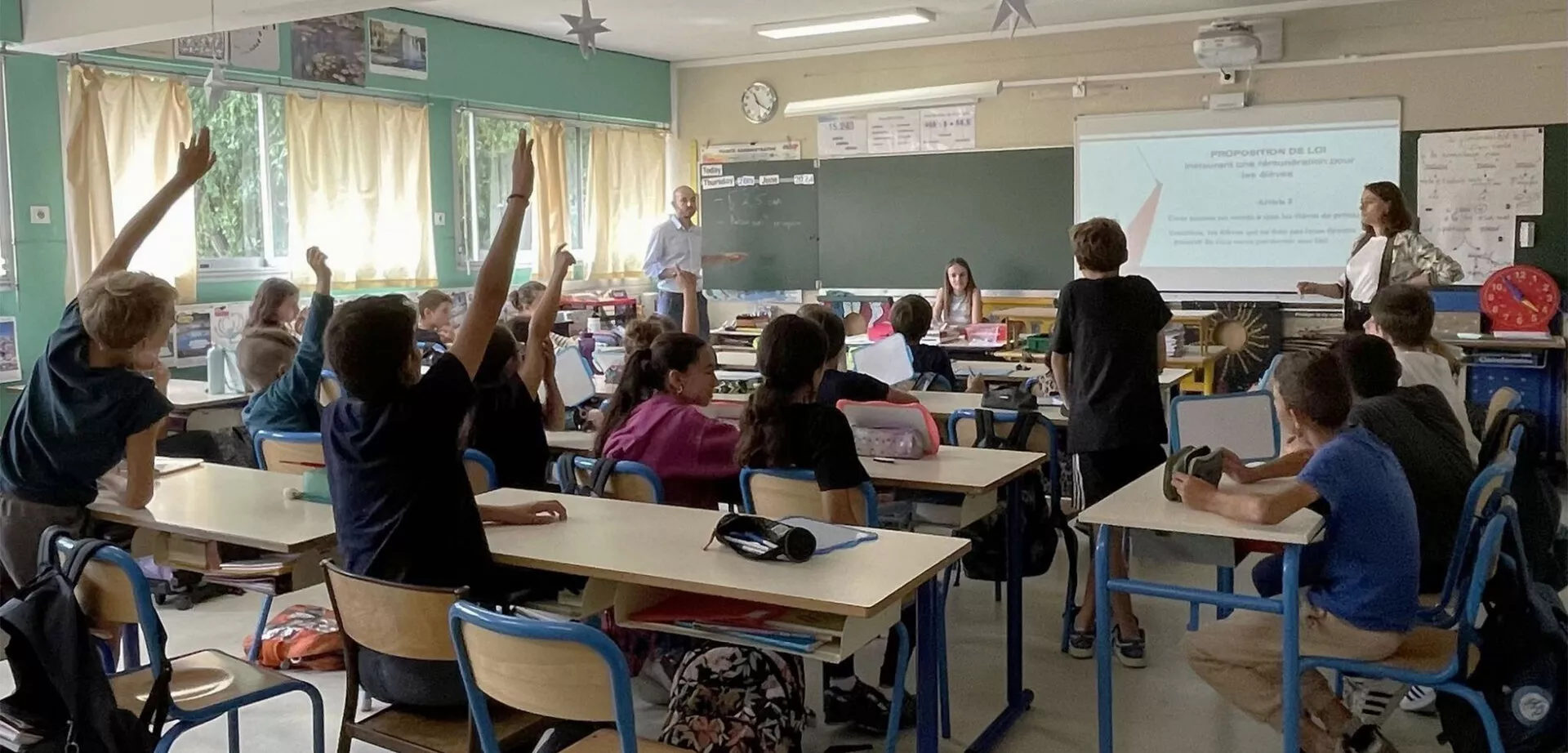
Promoting democracy: spreading knowledge about democratic institutions.
The 29 Haussmann Foundation, which works to give children the best chances to grow and become the citizens of tomorrow, has been supporting the association Parlons Démocratie since this year. We sat down with Raphaël Culliford, its Managing Director, who reflects on the importance of teaching young people about democratic institutions in a context where our democracies are increasingly fragile.
Parlons Démocratie celebrated its 5th anniversary this year. How did the association come about?
It was founded in 2020 by a group of parliamentary civil servants eager to share their knowledge and experience of public institutions with younger generations. The association was born out of an awareness of the fragility of our democracies, evidenced by rising voter abstention—particularly among young people—growing distrust of democratic and judicial institutions, increasing polarization of political opinions, and the shrinking space for genuine public debate. The founders were convinced that education was one of the solutions to these challenges, and that they needed to meet young people in person to help them understand how democracy works and how institutions—often perceived as abstract and distant—function.
How does Parlons Démocratie engage with young people?
Our initiatives are always based on a participatory approach and take the form of simulations of parliamentary debates, trials, municipal council meetings, or encounters with professionals from public institutions. We also invite young people to take part in rewriting the internal regulations of their schools.
These formats—led by judges, territorial and European civil servants, and parliamentary officials—allow young people to grasp democracy in action in a concrete way. The association primarily works directly within schools, bringing professionals from institutions into classrooms. It also enables young people to discover institutions firsthand by organizing visits or events within major public institutions.
What do you suggest to adress these fears and obstacles ?
After the discovery phase we move onto diagnostics. We listen to the client’s wishes, present the current state of affairs, the figures, and encourage them to think about their future plans.
Using behavioral finance to identify biases and drawing on the information we have, we present the client with alternative paths to what they might have imagined. For example, if a client wants to give everything to their children, we help them ask the right questions, always supporting our reasoning with data.
In summary, we do not present our clients with the best, but with the solutions best suited to their needs. Our role is to tighten the decision framework and narrow down the overabundance of choices, so that they can make the best decisions for themselves and their loved ones.
What impact do you see in the classrooms that follow your program?
By revealing the inner workings of institutions through people who know them from the inside, we aim to spark curiosity in young people and build confidence in their ability to shape the democratic future. We observe a genuine interest among young people in these issues. Thanks to the actions carried out in the field, students gain a better understanding of how institutions function, develop their ability to express opinions, argue, listen, and engage in debate. These activities also allow them to discover careers linked to democratic life, particularly in law and justice—often inspiring professional vocations!
What are your next priorities ?
We aim to continue expanding across the entire national territory by creating local branches in the regions and overseas territories. We believe it is essential to engage with professionals from institutions at the local level and reach audiences who are structurally more distant from these issues—particularly in rural areas and schools within priority education networks. Our ambition is for as many young people as possible to benefit from our support and actively participate in democratic life! After raising awareness among 16,000 young people in 2024, our goal is to reach 25,000 students in 2025 and then 40,000 in 2026.
A final word?
In a context where the vitality of democracy depends more than ever on citizens’ understanding and trust in their institutions—while storm clouds gather around democracies worldwide—we believe this should not be seen as a cause for discouragement, but rather as an additional source of motivation. It underscores the absolute necessity of contributing, at our own scale, to making democracy everyone’s business!
Parlons Démocratie in Numbers
In 2025, 25,000 young people will be engaged across France.
Over 500 volunteer speakers from national, judicial, administrative, local, and European institutions.
Learn more about the association Parlons Démocratie
The 29 Haussmann Foundation works to support children, with the objectives of promoting academic success and personal development, strengthening young people’s sense of citizenship, and contributing to social cohesion—paying particular attention to children who may suffer from various forms of exclusion.
To learn more about the foundation’s mission and actions, visit the dedicated page: Fondation 29 Haussmann

There seems to be an apparent contradiction between “transforming” money into lead and the ability to sell several...

In a context marked by declining interest rates, easier access to financing, and a recovery in transactions, the outlook...

According to the Family Business Institute¹, around 30% of family businesses survive into the second generation, 12%...

In a world in constant motion, where economic, social, and technological transitions are redefining business models,...

At the heart of the technological and energy revolution, rare metals have become a key strategic lever for supporting...