Mega-Brands: the new competitive landscape

Historical Advantages Are Now More Widely Accessible
The first explanation lies in the gradual lowering of barriers to entry. Resources once reserved for large corporations are now accessible to much smaller companies.
It is no longer necessary to own factories to develop a product. To illustrate this evolution, financial research firm Bernstein challenged itself to create its own footwear brand². By relying on external suppliers, its teams developed a pair of shoes in less than four months, compared with development cycles of 12 to 18 months among established industry players. Manufactured in Europe for less than €50, the product demonstrates the broader access to industrial expertise and high-quality production capabilities, which are now available to new entrants without requiring major industrial investments.
The same shift can be observed in distribution. Brands can now sell directly online, outsource logistics and quickly access multiple markets. They no longer need to build extensive retail networks or convince major distributors in order to reach customers.
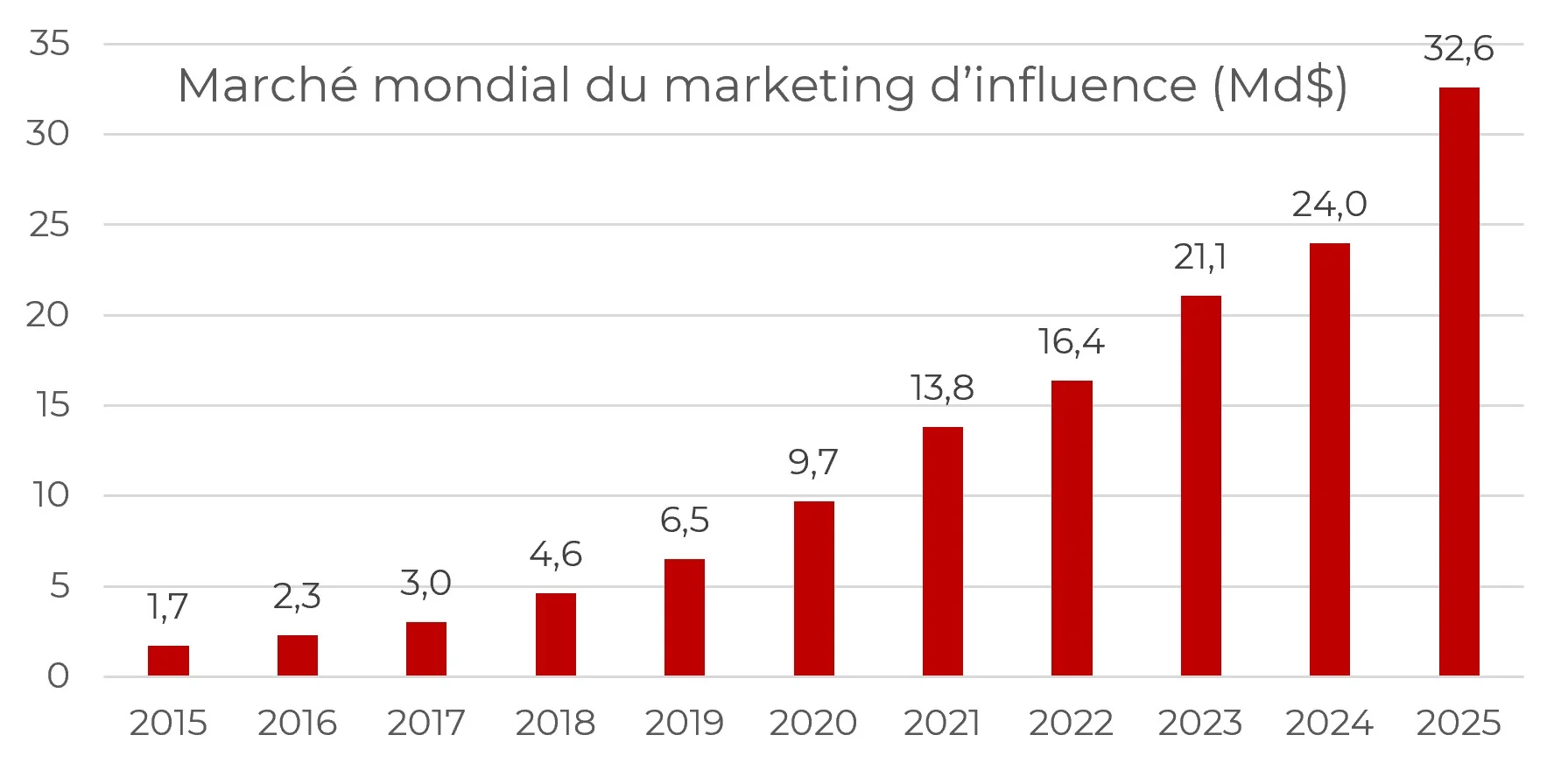
Social media has also profoundly transformed the way brands communicate. Rather than financing large-scale campaigns aimed at the widest possible audience, new players can target specific communities and scale their investments as they grow. The global influencer marketing market has expanded from $1.7 billion in 2015 to $32.6 billion in 2025³. Visibility now depends less on the scale of the resources deployed than on the ability to understand an audience.
Relevance Has Become a Key Criterion
This reduction in barriers to entry comes at a time when brand recognition plays a less decisive role in purchasing decisions. In the apparel and footwear sectors, brand ranks only seventh among the criteria considered by US consumers, behind factors such as fit, style, quality and price⁴.
Online reviews, comparison tools and recommendations now allow consumers to assess a product before purchasing it, even when it comes from a relatively unknown company. According to Bernstein data, 89% of US consumers consult reviews before making a purchase decision, and 70% say they would not buy a product online without first reading them². The trust that was once delivered primarily through a logo can therefore now be built through other channels.
The relationship consumers have with brands also varies significantly by generation. In the United States, 74% of consumers from older generations describe themselves as loyal to specific brands or retailers, compared with only 64% among younger generations⁵. This gap reflects a greater openness to discovery and brand switching, which contributes to challenging established market positions.
From Scale to Precision
Major brands were built for a relatively homogeneous market, dominated by a limited number of media outlets and broadly shared trends. Digital technologies have fragmented this environment into a multitude of communities, each with its own specific expectations.
Within this new framework, challengers no longer need to address the entire market. They can focus on a specific use case or customer segment, launch an offer quickly, measure the market's response and adapt accordingly. Their advantage lies less in the scale of their financial resources than in their specialisation and speed of execution.
By contrast, major brands must continue serving numerous markets, categories and customer groups. This broad coverage, once regarded as a strength, can slow decision-making, increase the complexity of product offerings and make it more difficult to identify emerging trends.
This trend does not signal the disappearance of major brands, but it does call into question the traditional advantages associated with scale. Being well known, producing at scale and benefiting from global distribution remain valuable assets. However, these factors alone are no longer sufficient to sustain growth over the long term.
In a market that is increasingly fragmented and transparent, competitive advantage is gradually shifting from scale to precision. It belongs to those players that best understand their customers' expectations and are able to respond most effectively and rapidly.
Sources:
GlobalData, evolution of apparel brands' market shares, 2016-2025.
Bernstein, The Death of the Billion-Dollar Brand, 2026.
Statista, global influencer marketing market, 2015-2025.
Bernstein US Shopper Survey 2024.
YouGov Survey, October 2024.
This content, being of an advertising nature, has no contractual value. It is neither intended to provide an investment service such as investment advice, nor any related investment service, nor advice on arbitrage, nor legal, accounting, or tax advice from Société Générale Private Banking France (hereinafter "SGPB France"), which therefore cannot be held responsible for any decision made by an investor solely based on its content. SGPB France does not undertake to update or modify it.
Before making any investment decision, please review the detailed documentation of the service or product considered, notably the information related to associated risks, and consult your legal and tax advisors. If the content is accessed by a non-French tax resident, they must ensure with their legal and tax advisors that they comply with the legal and regulatory provisions of the relevant jurisdiction. It is not intended to be distributed in the United States, nor to a US tax resident, nor to any person or in any jurisdiction where such distribution would be restricted or illegal.
Société Générale has implemented a conflict of interest management policy. Société Générale Private Banking France has put in place (i) a complaints handling policy for its clients, available upon request from their Private Banker or on its website (https://www.privatebanking.societegenerale.com/en/claims/) and (ii) a personal data protection policy (https://www.privatebanking.societegenerale.com/en/personal-data-protection/). At any time and free of charge, you have the right to access, rectify, restrict processing, erase your data, and object to its use for commercial prospecting purposes by contacting our Data Protection Officer by email (protectiondesdonnees@societegenerale.fr). In case of dispute, you may file a complaint with the French Data Protection Authority (CNIL), the supervisory authority responsible for ensuring compliance with personal data obligations.
This document is issued by Société Générale, a French bank authorized and supervised by the Autorité de Contrôle Prudentiel et de Résolution, located at 4 Place de Budapest, 75436 Paris Cedex 09, under the prudential supervision of the European Central Bank ("ECB") and registered with ORIAS as an insurance intermediary under number 07 022 493, orias.fr. Société Générale is a French public limited company with a share capital of EUR 939,654,993.75 as of 23 February 2026, whose registered office is located at 29 boulevard Haussmann, 75009 Paris, and whose unique identification number is 552 120 222 R.C.S. Paris (ADEME FR231725_01YSGB). More details are available upon request or on www.privatebanking.societegenerale.com/. This content may not be communicated or reproduced in whole or in part without prior written consent from Société Générale Private Banking France.